

Essay Read by Constituting America Founder, Actress Janine Turner
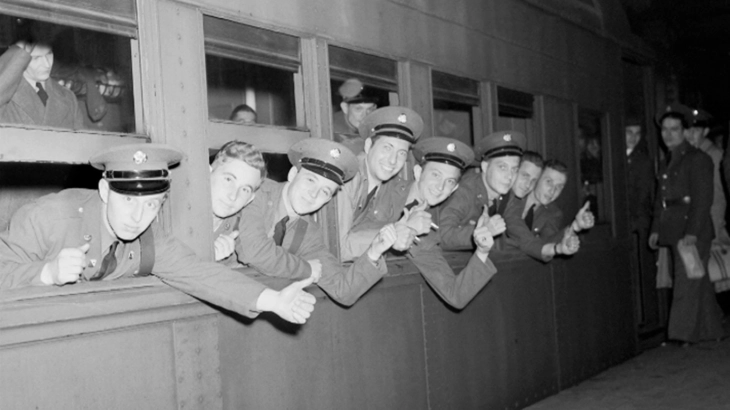
In 1944, President Franklin Delano Roosevelt signed into law the Servicemen’s Readjustment Act of 1944, commonly called the G.I. Bill. The bill made provision for a variety of economic and educational benefits for almost all veterans of World War II. Among other provisions, the bill provided tuition and a living stipend for veterans returning to school, unemployment benefits for veterans unable to secure employment, and subsidized loans for home building and business ownership.
The World War II American military was largely a volunteer force, not a long-term professional one, and huge swaths of people serving would be rotating out of their military careers in short order as the war reached its end. The American people and the policymakers representing them were rightly concerned about how those former servicemembers might best be integrated back into civilian life. In short, the bill was designed to secure the educational and economic well-being of millions of veterans at a pivotal juncture in American history broadly and American military history specifically.
The G.I. Bill in its original form was conceived of as a payment of a debt owed to servicemembers whose civic virtue was exemplary and admirable. In his signing statement in 1944, FDR declared that the bill and associated legislation “provide the special benefits which are due to the members of our armed forces—for they have been compelled to make greater economic sacrifice and every other kind of sacrifice than the rest of us and are entitled to definite action to help take care of their special problems.” That those same servicemembers who made those definite sacrifices should have the opportunity to receive a suitable education, pursue entrepreneurship, or own a home seemed like common sense at the time and has seemed so to multiple generations of legislators who have passed subsequent bills providing similar benefits to veterans.
The Constitution’s lofty goals are announced as a joint project of “We the People of the United States,” coming together to form a government aiming at all the things described in the preamble. But who constitutes the “people?” In one sense, it is all citizens, of course, but the intuition of many is that it is more properly those with some demonstrated stake or engagement in their community. In the colonial and Founding eras, this sometimes took the form of property requirements for citizenship. On his father’s passing, for example, John Adams inherited a plot of family land and became a “freeholder,” and by virtue of that ownership was both able to participate in town council meetings and actually obligated to hold some sort of office of public service.
Though we have, for perhaps good reasons, moved away from land ownership or other similar requirements as prerequisites to an equal voice in our political process, there are many reasons to still value the concept of “buy-in” in a democratic republic. When we imagine an ideal citizen, we might conceive of someone like a G.I. Bill beneficiary: someone who voluntarily served their country and put themselves at risk. We might also think of broader concepts of citizenship and imagine someone integrated in their local community, engaged in public service, volunteer work, community organizations, and the like.
Someone who is well educated and economically secure is by leaps and bounds more likely to be able to pursue these time-consuming activities. If this sort of civic engagement constitutes at least one part of “good citizenship,” and voluntary service constitutes another component, the G.I. Bill and its later counterparts ought to be quite directly shaping better citizens. It would, in other words, be taking the people we might most expect to demonstrate some selfless and civic virtues and giving them the opportunity to develop and apply those to civilian life.
Indeed, the effects of the G.I. Bill on this sort of civic engagement are, by some accounts, measurable. Political scientist Suzanne Mettler’s 2007 book Soldiers to Citizens: The GI Bill and the Making of the Greatest Generation argues that one of the greatest benefits of the G.I. Bill was creating what we think of as the “Greatest Generation.” Those who took advantage of its benefits and thereby received an education and economic advantages after their military service were far more likely to engage in those things we traditionally associate with “civic life”: volunteering, associational memberships, and community work. In other words, by Mettler’s account, the G.I. Bill was a success.
While one can certainly imagine other causal explanations for the surge in civic activity undertaken by the “Greatest Generation,” such as the camaraderie developed through the process of training, shipping out, fighting, and returning, generations of Americans have shared FDR’s belief that those who undertake definite sacrifice deserve definite benefits. But those benefits are not limited to beneficiaries of the bill and their children, for all Americans benefit when more Americans are civically engaged.
 Philip D. Bunn is an assistant professor of political science at Covenant College in Lookout Mountain, Georgia. His research has been published in Political Research Quarterly and American Political Thought, and his reviews and essays have appeared in The Review of Politics, Plough Quarterly, Current, and The University Bookman, among other publications.
Click here to receive our Daily 90-Day Study Essay emailed directly to your inbox.
Click here for the essay schedule with today’s essay and previously published essays hyperlinked.
