
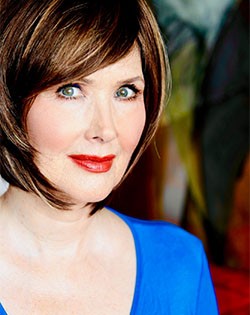
Essay Read by Constituting America Founder, Actress Janine Turner
We Did Not Get to the Moon by Accident
People forget how many people it took. Not the astronauts. Everybody remembers the astronauts. Neil Armstrong and Buzz Aldrin got the parades, the magazine covers, and the footprints in the history books, and they earned every bit of it. But behind them stood 400,000 Americans, including engineers, mathematicians, seamstresses, welders, machinists, typists, and scientists. Most of them never got a parade. Most of them went back to work the next morning like it was any other day. That’s the real story of Apollo.
Americans were in a race. The Soviets put Sputnik into orbit in 1957, and Americans felt it in their bones. The Cold War wasn’t a metaphor. It was a real contest between two ways of living: one where the state directs everything, and one where free people, working together by their own will, can achieve great accomplishments. When the Soviets put Yuri Gagarin into space in April 1961, the pressure on the United States became enormous. Six weeks later, Kennedy stood in front of Congress and said that the country would put a man on the moon before the decade was out. Not because it was easy, but because it was hard.
What came next was the largest peacetime scientific and industrial mobilization this country has ever seen. NASA couldn’t do it alone. They contracted thousands of companies. North American Aviation built the command module. Grumman built the lunar module. IBM wrote the software. A factory in Massachusetts sewed the spacesuits by hand, the same hands that usually made bras. That detail matters. It tells you who built Apollo and what free people can do when they give themselves to a mission.
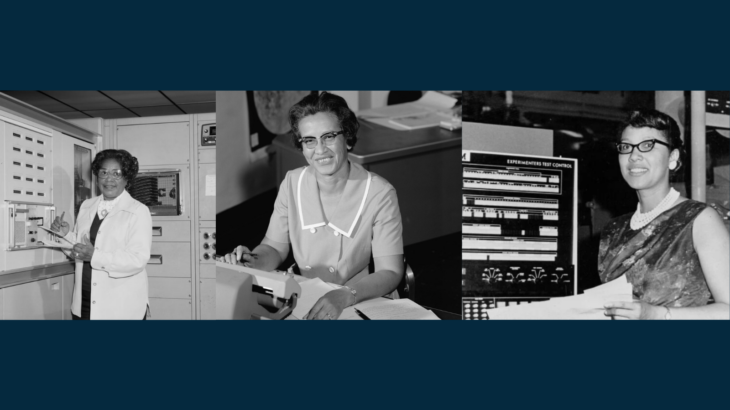
We’re only now learning to properly credit the women who made it possible.
Katherine Johnson sat at a desk at Langley and calculated orbital trajectories by hand, more precisely than the early computers could. When John Glenn was preparing for his Friendship 7 orbit in 1962, he refused to fly until Katherine checked the numbers herself. He was a man staking his life on the math of a Black woman in Jim Crow Virginia because he knew she was the best. She was.
Dorothy Vaughan ran the West Computing pool at Langley, a group of Black women mathematicians working in a segregated building with segregated bathrooms, doing the work that kept NASA flying. When the IBM computers showed up, she didn’t wait to be trained. She taught herself FORTRAN and taught her whole team. She got ready for the future before it arrived.
Mary Jackson wanted to be an engineer. NASA told her she’d need classes at a segregated, whites-only school that didn’t take Black students. So, she went to court to get in. She won. She became NASA’s first Black female engineer and spent the rest of her career clearing the path for other women.
The Declaration of Independence asserted that all men are created equal. The women computing Apollo’s flight paths knew better than anyone that America hadn’t lived up to those words for everyone yet. They showed up anyway. They did the work anyway. That’s not blind loyalty to a country that hadn’t kept its promise. That’s the deeper patriotism, the kind that holds a country to its own founding words. Most Americans didn’t even know their names until 2016.
Nobody was guaranteed to succeed. The program lost three men on the launchpad in January 1967, Gus Grissom, Ed White, and Roger Chaffee, and kept going anyway. They fixed what was broken and pressed on. That’s what consent of the governed actually looks like: free people pushing through adversity because they believe it’s worth it. Not because a government ordered them to, but because they decided to.
On July 20, 1969, Neil Armstrong stepped onto the lunar surface. Across America, people watched on grainy black and white televisions and cried. It was magnificent. But it was also collective: the seamstresses who sewed the suits, the women who did the math, the engineers who worked through the night, and the families who said goodbye and meant it. Four hundred thousand Americans who never got the parade but built the rocket anyway.
The Declaration of Independence turned 250 years old this year. Americans celebrate it with grand fireworks and speeches, and that’s the right thing to do. But the deeper celebration is this: the document was never a guarantee. It was a challenge. A statement of principle with responsibilities for every generation that came after. The proof is not in the words. It is what free people do with their freedom.
Katherine Johnson, Dorothy Vaughan, and Mary Jackson answered that challenge in a segregated building in Virginia with pencils, slide rules, and iron will. So did the welder in Ohio, the software writer in Massachusetts, the seamstress in Worcester, and the flight director in Houston who had to decide, after three men died, whether to keep going.
They kept going, and two Americans stood on the moon!
That’s what a free people can do when they decide to.

Brita Horn lives on a 5th generation family ranch in a tiny town in northwestern Colorado, where she has been a volunteer fire chief for nearly two decades. She is a ranch wife, mother and grandmother who finds her deepest convictions not in institutions but in the people around her, the ones who get up early, do the hard work, and never ask for recognition. She is also the author of Drinking from a Fire Hose: 5 Essential Tools to Not Get Soaked. This essay grew out of her belief that the American story has always been carried by ordinary families doing extraordinary things.
Click here to receive our Daily 90-Day Study Essay emailed directly to your inbox.
Click here for the essay schedule with today’s essay and previously published essays hyperlinked.
